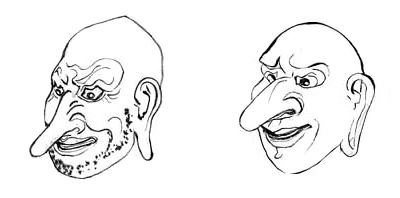
The path purifier, mask worn by the first actor in a procession of ancient theatrical performances gigaku 伎楽. Presumably he secured or purified the way tsuyubarai 露払, for all those behind. The Records of Saidaiji (Saidaiji shizaichō 西大寺資財帳; 780) mention him carrying a banner, and early references also suggest he was closely followed by two unmasked men who held a canopy over him. Though quite some variety appears in coloring and in the age of the man represented, all examples of the mask have uncommonly long, bill-like noses. In some Chidō masks, such as a 7th-century work at Hōryūji 法隆寺, holes remain at the forehead indicating that a metal crown was probably attached. A typical early mask (red painted wood with appended strands of hair at eyebrows and crown) in the *Shōsōin 正倉院 shows a fleshy, bearded, smiling middle-aged face dominated by the long nose. It has been suggested that representations of Chidō are the predecessors of long-nosed goblin *tengu 天狗 masks used after the Kamakura period in many festivals.