Lit. "side arrow."
1 Attacking from the side. Also sokusha 側射, sokubō 側防. An arrow, gun, or a cannon attack on one side of enemy lines, to prevent the enemy scaling a castle entrance or embankment. Usually a specially built structure or bends in the castle ramparts are used for this purpose, see 2 below. These side attacks are called *jun'yokoya 順横矢 when launched from the left side of the castle entrance, and gyakuyokoya 逆横矢 when attacking from the right of the entrance, as viewed from outside the castle .
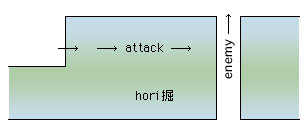
*jun'yokoya 順横矢
2 Any castle structure built to attack the enemy from the side, see 1 above. This included bent, curved, or indented embankments, ramparts and moats, and special compounds and towers for side attacks. Medieval mountain castles often had yokoya towers separate from the main castle, whilst castles built by later members of the Hōjō 北条 clan had bends built into dry moats *karabori 空堀 for this purpose. Medieval yokoya were usually curved in shape maruyokoya 丸横矢, but in the Edo period stone-faced ramparts *ishigaki 石垣 meant that castle structures could contain sharp bends. Yokoya with right-angled or acute-angled bends were developed, gradually increasing in complexity. Examples include the folding screen type yokoya byōbu-ori 横矢屏風折, dropped-off corner type *yokoya sumi-otoshi 横矢角落, and the square type *yokoya masugata 横矢桝形.