Also written 裳層. Also pronounced shōkai. A pent roof enclosure usually one bay deep. Its structure may extend from the aisles *hisashi 廂 on one to four sides. Mokoshi may also surround the core *moya 母屋 of a building directly. If that is the case the hisashi are omitted. The difference between hisashi and mokoshi is that the tie beams *nuki 貫 of the mokoshi are directly inserted into the shafts of the pillars. It looks like a two-storied building from outside, although this is not, in fact, the case. Its roof and enclosure are like a skirting. Mokoshi were widely used in *zenshūyō 禅宗様 architecture introduced to Japan in the late 12th century. The Tōshunji Kannondō 洞春寺観音堂 (1430) in Yamaguchi Prefecture is a good example. Yakushiji Tōtō 薬師寺東塔 (early 8th century) in Nara appears to be six stories, but that is because a mokoshi was placed between each story. During the 16th-19th century, pent roof construction was called *yuta-zukuri 雪打造.
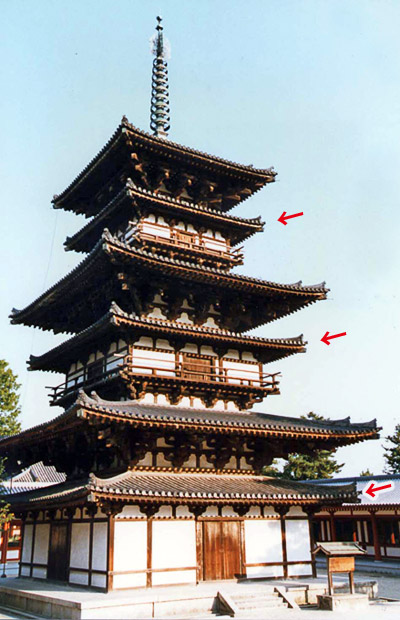
Yakushiji Tōtō 薬師寺東塔 (Nara)