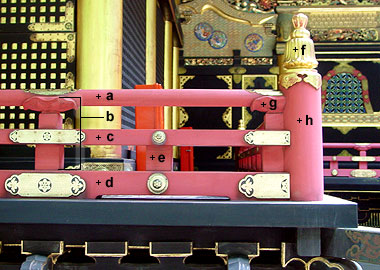
Also called Karayō kōran 唐様高欄. A railing or balustrade *kōran 高欄 with features characteristic of the Zen 禅 style. The most easily identified is the newel post *giboshi 擬宝珠, which has an inverted, stylized lotus flower *gyakuren 逆蓮, with a tapered stem that extends upward or has petals that are slightly flared with a bulbous form on top. Newel posts also have upright, half-opened, simplified lotus patterns or one atop the other holding an undecorated bulbous form. The top railings are supported by carved lotus leaf struts *kayōzuka 荷葉束. When used on altars *shumidan 須弥壇, the top rail *hokogi 架木, often slopes downward in an elongated curve toward the center front. When compared to Japanese style *wayō 和様 railings, the Zen style railings are conspicuous for the use of ornamentation and curvilinear forms.
Examples: Engakuji *Shariden 円覚寺舎利殿 in Kanagawa Prefecture, Rinnōji Taiyūin *Reibyō 輪王寺大猷院霊廟 (1653) in Tochigi Prefecture, Buttsūji Gankiin Jizōdō 仏通寺含暉院地蔵堂 (1407) in Hiroshima Prefecture.
Zenshūyō kōran 禅宗様高欄
Keywords
Architecture
General Terms