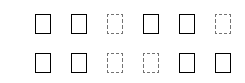
The various systems of placing rafters *taruki 垂木 in relation to the pillars *hashira 柱, and the width of the bay *ken 間 measured from pillar center to pillar center. No truly systematic arrangement for positioning parallel rafters existed before the 14th century. But a tendency toward a more formal system began in the latter 12th century, exemplified by the rafter system on *Sanjū-no-tō 三重塔 (1171) at Ichijōji 一乗寺 in Hyōgo Prefecture. Gradually, orderly arrangements were devised. The following are the most common:
1) Rokushigake tarukiwari 六枝掛垂木割. The even distribution of six rafters on three bearing blocks *mitsudo tokyō 三斗斗きょう, i.e. two rafters positioned above each of three bearing blocks supported by a bracket arm *hijiki 肘木. The space between the rafters equals the height of the rafters; thus, the distances from rafter center to rafter center are the same. These are units of measurement called *isshi 一枝. Also called honshigewari 本繁割, rokushigake mitsudo 六枝掛三斗 or rokushigake 六枝掛. This arrangement became widespread by the 14th century but was not documented until the Edo period.
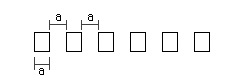
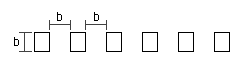
2) *Shigedaruki 繁垂木 (shigedarukiwari 繁垂木割). Closely spaced parallel rafters. If the width of the edges of a rafter is equal to the space between the rafters, it is called komagaeshiwari 小間返割. If the height of a rafter is equal to the space between the rafters, it is called segaeshiwari 背返割. Sometimes the former are equated with shigedaruki while the latter are referred to as honshige darukiwari 本繁垂木割. Shigedaruki are also known as shigemono 繁物 (densely placed things).
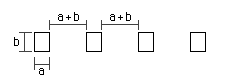
3) *Hanshige daruki 半繁垂木 (hanshige darukiwari 半繁垂木割 or hanshigewari 半繁割). Fairly widely spaced rafters. The space between them is about equal to the sum of the underside of the rafter plus the height; often twice as far apart as shigedaruki.
4) *Mabaradaruki 疎垂木 (mabaradarukiwari 疎垂木割, a sparse number of rafters). Rafters placed with very wide spaces between them. There are fewer than half the number of rafters compared to the number needed for closely spaced shigedaruki. Also called ōmabara darukiwari 大疎垂木割.
5) Chūmabara tarukiwari 中疎垂木割. A rafter taruki, placed so that it goes over the center of each pillar hashira. The space between the pillars is divided into six parts allowing the positioning of five rafters.
6) Komabara tarukiwari 小疎垂木割. A rafter that passes over the center of a small bearing block *makito 巻斗.
7) *Fukiyose daruki 吹寄垂木 (fukiyose darukiwari 吹寄垂木割). Two or three rafters closely placed together followed by a wide space and then two or three more. The pattern is repeated. Such variations are common in tea ceremony architecture. See *fukiyose 吹寄.
2)*shigedaruki 繁垂木
komagaeshiwari 小間返割
2)*shigedaruki 繁垂木
segaeshiwari 背返割
(honshige darukiwari 本繁垂木割)
3)*hanshige daruki 半繁垂木
4)*mabaradaruki 疎垂木
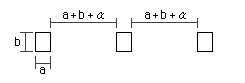
7)*fukiyose daruki 吹寄垂木