Also called tomebuta 留蓋; amabutagawara 雨蓋瓦; sumibutagawara 隅蓋瓦. A cover tile, usually hemispherical but sometimes square, used to prevent roof leaks where three tiles come together near the end of the corner of a roof. The three tiles are: 1) hanging tiles *kakegawara 掛瓦, i.e. those which are laid at right angles to the bargeboard *hafu 破風 and protrude beyond its edge. 2) the corner tile or hip tile *sumidomoe 隅巴 at the end of a corner ridge *sumi kudarimune 隅降棟. 3) the convex semi-circular eave-end tile *nokimarugawara 軒丸瓦 with pendant *gatō 瓦当 attached. The sleeve tiles *tonemarugawara 利根丸瓦 or *sodemarugawara 袖丸瓦 border the hanging tiles. Because the tile's sides are of differing lengths, adjustments to their height at the inner ends must be made. This is accomplished by chipping off where necessary in order to fit the three tiles at the corner end against the sleeve tiles. Without a cover tile, rainwater would easily seep through the places where the tiles meet. These are usually made as a set today.
Although plain, undecorated tomebuta can also be seen, most have an added three-dimensional sculpture decorating the top. These sculptures exhibit an enormous diversity of very imaginative molded clay images. They include birds, turtles, lions and other animals, peonies, chrysanthemums and other flowers, human figures, for example, a little man carrying money bags, and standing waves. Many of these tiles were hand molded. In recent centuries, molds have come into use with liquid clay poured into them.
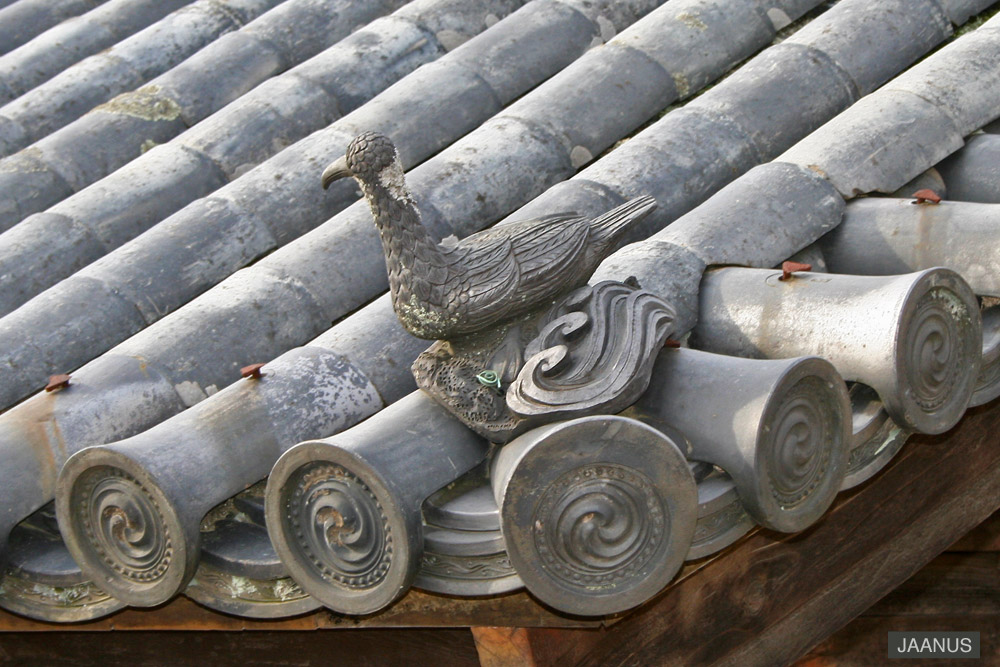
Tōdaiji Nigatsudō Akaiya 東大寺二月堂閼伽井屋 (Nara)